

Pond FAQ's
We get many questions about pond building, pond maintenance, pond pumps, plants and koi.
We have listed the most common questions here in hopes that you will find the answers you seek.
You can also post your question on our Facebook page or Pond Blog.
-
How do I get rid of green water?
For clarity issues, Rapid Clear, a flocculent that is 100% safe for fish, plants or wildlife, can be used. This product is a fast acting treatment that can solve cloudy water in just a few hours by physically causing the particulates floating in the water to clump together into larger particles that can be filtered out.There are several other effective products that you can use to help clarify the water. A combination of our Beneficial Bacteria, EcoBlast and SAB is the ultimate way to have perfectly balanced, clear water. The Beneficial Bacteria for Ponds/Dry and SAB both help consume excess nutrients in the water, break down decaying organics and reduce sludge and odor issues. SAB also includes a powerful phosphate binder that locks up this nuisance nutrient. These two products can be used as often as once a week.Finally there are UV filters. Aquascape offer two types, the Aquascape UltraKlean Pressure Filter with UV or the Aquascape UltraKlear UV Clarifier. The new Aquascape UltraKlean pressure should be place beside the pond (not inside the pond!). A pump sitting inside the water will push the pond water through the UltraKlean, exposing the water through biological filtration, a high-output UV bulb, and then back into the pond. Using this method, the UlteaKlean will allow you to have clear water and the low maintenance water feature you have always wanted!The Aquascape UltraKlear® UV Clarifier is ideal for eliminating green water on new or existing ponds up to 5,000 gallons. Learn about the features and benefits from Scott Rhodes, The Product Guy, and what separates Aquascape's UltraKlear® apart from the rest.There are many other factors that may be the cause to these water clarity issues. Temperature (Has the temperature fluctuated in your area lately?), the location of the pond (direct sunlight/shaded) and the surrounding environment (mulch, trees, plant life, etc.). If you continue to experience problems with your water, please feel free to call The Pondmeister.
-
I have to replace my liner. How do I transition my fish without problems?
Make sure you put an aerator in the pond-(the Pond-Air Two Stone or Four Stone Aerator would be perfect) to keep the fish oxygenated in such close quarters. Then use DeTox to remove chlorine and other heavy metals before you put the fish back in the new water.
-
What are the best ways to keep my pond water clean and clear?
The most frequently asked questions are all about water clarity and algae control. Here are links to videos, articles and products to help solve your most pressing pond problems!
I get asked at least 5 times a day in the summer the dreaded “Why is my water green?” or “How do I get rid of algae?” questions. I have written a blog post to share the keys to a clear, algae-free pond. Click here to read the entire article.
If you already have a growth of string algae in the spring, we have found it most effective to apply EcoBlast every 3 days for 2 – 3 weeks until you are in control and then drop back to once a week for the remainder of the summer. See the Ecoblast product video.
If you are concerned about the use of algaecides and want to absolutely eliminate all of the string algae, please check out the Iongen electronic clarifier. Read more and see the Iongen video.
See all Algae Control / Pond Water Treatment options on our website.
-
What size pump do I need?
The pump is one of the most important equipment purchases you will make for your water garden. It is the heart of the pond, circulating water to the filter and keeping the ecosystem healthy. Because it runs constantly, it must be both dependable and energy efficient. The pump you choose is based on the size of your pond and the pumping capacity in gallons per hour (gph). The pump should circulate the entire volume of the pond at least every hour. So, if you have a 1000-gallon pond, you need a pump that handles at least 1000 gph. When in doubt, you should purchase a slightly more powerful pump. You can always slow or divert the flow of a pump, but you can't increase it.
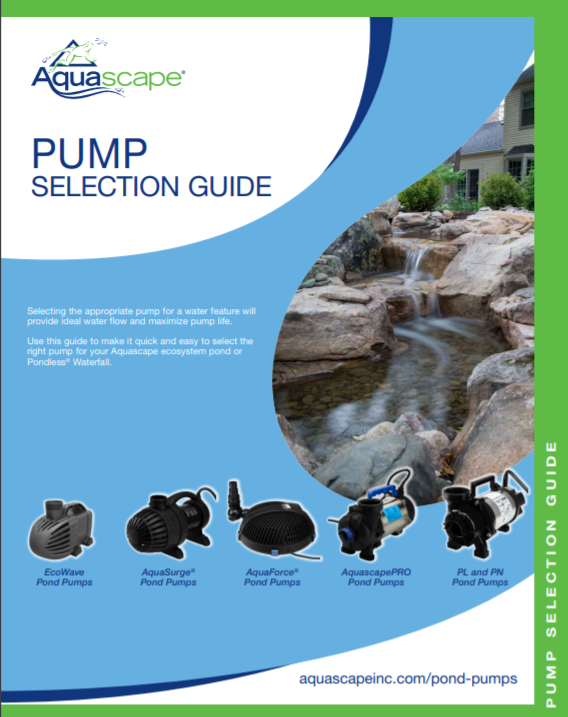
Click to see the Pump Selection Guide
We have many informational videos and articles related to pond pumps on our Pond Blog
-
What pump should I use for a waterfall?
To choose the proper pump for a waterfall, you first need to understand pump head height. This is the water pressure generated by a pump. The maximum pumping height is the height a pump will raise water straight up resulting in zero gph of water flow at the top. As the height of any pump discharge increases, the flow will decrease. For example, a 1000 gph pump may pump 850 gph at a height of two feet, but only 500 gph at a height of ten feet. To calculate the pump size for your waterfall, decide the width of the spillover you want and determine the vertical distance from the top of the waterfall to the pond surface. Every inch of spillover width requires between 100-200 gph of water flow at the height of the waterfall. For example, if you want an eight-inch wide stream over a waterfall that is four feet above the pond, you need a pump with a flow rate of at least 800 gph at a height of four feet. Again, when in doubt always purchase a slightly more powerful pump. You can always slow or divert the flow of a pump, but you can't increase it.
For a light flow, you can figure 50 gph times the width of your waterfall (in inches), 100 gph for a average flow and 200+ gph for a strong flow.Waterfall products and informational videos can be found on our Pond Blog.
-
Can I turn off my pump at night?
No! Not if you have fish. Nighttime is the absolute worst time to turn off the pump. During the day plants take CO2 from the water and give off oxygen. At night, however, plants turn into Mr. Hyde by stealing oxygen out of the water and giving off CO2. Aeration is vital to your fish and lack of aeration will kill.
-
Can a pond run throughout the winter?
Yes, although maintenance is usually the determining factor in whether or not a pond owner keeps their pump and waterfalls running in the winter. The primary maintenance responsibility at this time is to make sure there is enough water for the pump to operate properly.
During the winter months, the usual water supply options are not available. Outdoor water spigots and automatic water fill valves should be turned off to prevent pipes from freezing and cracking. Therefore, pond owners who run their systems during the winter will need to find an alternate water source to replenish their pond.
Water can be supplied from a hose run from inside the house or by making multiple trips with a five-gallon bucket. Generally speaking, it’s not uncommon to have to go out a few times a month during the winter to top off the pond, as water will evaporate slowly.
See the products for Pond Winterization. -
What is a Koi Pond?
A Koi pond is an enclosed, recirculating, freshwater system for keeping Koi (Japanese fancy carp).
Design Considerations for a Koi Pond.
- 500 gallons or larger. "The bigger, the better."
- 24 inches or deeper. Deeper is better. Does not take up any more space or proportionally more filtration.
- Straight or near vertical walls. Protection from predators and more pond volume.
- A bottom that slopes towards the drains and away from water falls or incoming water.
- Some form of surface skimmer. The pool and spa skimmers with a "weir" work best.
- A biological filtration system.
You can find pond kits and all pond supplies on our site. Post your questions on our Facebook page or Pond Blog.
-
Won’t the waterfall freeze solid?
Pump size is important when determining a waterfall’s ability to operate during the winter. A pump that provides at least 2,000 gph can be operated throughout the winter without a problem, as long as it runs continuously. Moving water will usually keep a hole open in the ice around the waterfalls and in front of the circulation system.
However, repeated days in sub-zero temperatures may lead to excessive ice build-up and can cause the system to operate improperly. If the flow of water into the circulation system is unable to keep up with the pump because of ice build-up, it may be necessary to shut the system down. The system can be run again once the ice is melted and normal water flow is restored. -
Will the filters and pipes crack?
Most good filters are constructed out of rotational-molded polyethylene, and are designed to bow and bend with the freezing and thawing effects of winter. The PVC flex pipe is reinforced and will not crack unless water is left in the pipe over the winter and allowed to freeze. If your customer decides to keep the pump running all winter long, there will still be a constant flow of water traveling through the pipe and the moving water will not freeze. If your customer decides to turn the system off for the winter, most of the water in the pipe will drain back into the pond when the pump is removed.
-
What are Koi?
The common carp is the forerunner of our present day Koi. Koi are not big goldfish. The goldfish is a distant cousin to Koi.
The Japanese name for Koi is Nishikigoi. Nishikigoi were developed by the Japanese over 200 years ago.
The average Koi can grow to 24 - 36 inches. The size of the pond, the amount of aeration, and feeding methods will affect the growth of the fish. It is not uncommon for a small Koi to grow 2 - 4 inches a year in a backyard pond.
These gorgeous creatures usually live in lushly landscaped fish ponds outdoors. The ponds are constructed to provide adequate oxygenation and filtration of the water. These ponds make an excellent landscaping addition to a garden.We carry all the supplies you need to keep your fish healthy and well fed. Fish food, medicated fish food, and feeding accessories.
-
What should I feed my fish and how often should I feed them?
Pond fish need the proper combination of protein, fats, fiber, minerals and vitamins. Too much or too little of any particular nutrient can have an adverse effect on both the health of the fish and the quality of the water. Fish should be fed one to two times daily. Only feed as much as they will consume within five minutes.
-
How many fish can I add to my new pond?
Make sure you don't overload your pond's ecosystem with too many fish. For a new pond, a good rule of thumb is one inch of fish per square foot of surface area. A mature pond can support two to three inches of fish per square foot. Once your pond is built, add the fish a few at a time over the course of 30 days to ensure that the pond and filter are biologically ready to support aquatic life. Simple precautions, such as testing water quality, neutralizing chlorine when adding water and protecting against common diseases, can assure your pond fish remain in optimum health.
-
Will my fish live through the winter?
Most of the time the answer is yes. It depends on where you are and how deep your pond is. Fish cannot survive in water temperatures of 36 degrees and below. They become semi-dormant in temperatures between 36 and 50 degrees and just hang around the bottom until the water temperatures begin to rise. If you are in a climate where the water freezes down several inches you definitely want to place a de-icer unit on the pond. De-icers switch on at 42 degrees and keep a hole in the ice for gases to escape.
For more information, read our blog post and watch the video How to Winterize Your Pond.
-
What are the benefits of adding plants to my pond?
Besides adding beauty to the pond, aquatic plants also provide welcome shade, which reduces algae growth, and natural filtration, which helps clean the water. After the bacteria in your filter break down harmful pollutants, plants are able to absorb and remove them from your pond. For optimal growth, remember to choose plants suited to your climate and to keep plants a reasonable distance away from moving water.
-
Do I really need a UV light in my pond?
If you ask 10 pond people the UV light question, you will probably get 2o different answers.
I am not a UV light fan so I may be the wrong person to ask.
The UV lights do kill some of the green water algae but also kill the beneficial bacteria as well. They have zero impact on string (mossy) algae.
If you have a well balanced ecosystem with mechanical (skimmer) filtration and biological (BioFalls) filtration and do the following correctly:
• Aeration
• Not too many fish
• Don’t overfeed the fish
• Plenty of plants for shade and competing with the algae for nutrients
• Correctly sized pump (Turn the water a MINIMUM of once per hour)
You should not need a UV light if you are doing the above properly. If you have some string algae, an IonGen only takes 1 watt and completely controls string algae.If all else fails, by all means try a UV light. Make sure that you match up the proper size pump to the UV. If you have too big a pump for the UV light, the water will pass through too quickly and not be effective